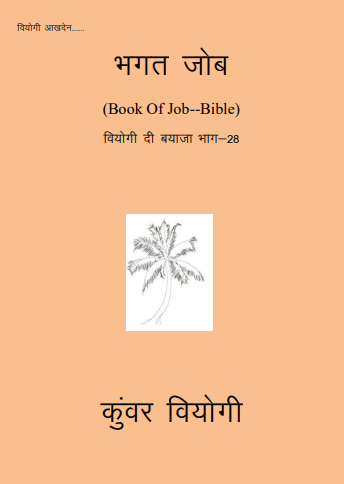
Sonnets - Kunwar Viyogi
SONNETS IN ENGLISH & DOGRI

04.9.1940 –16.09.2015
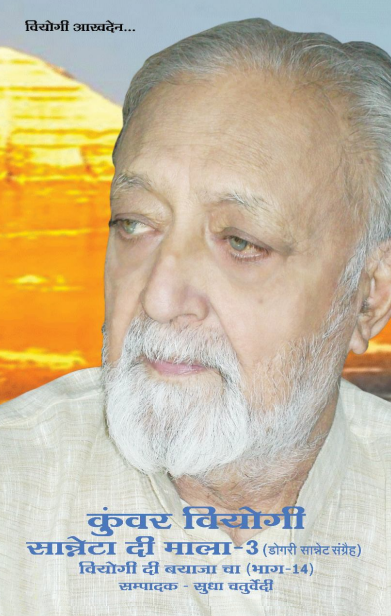
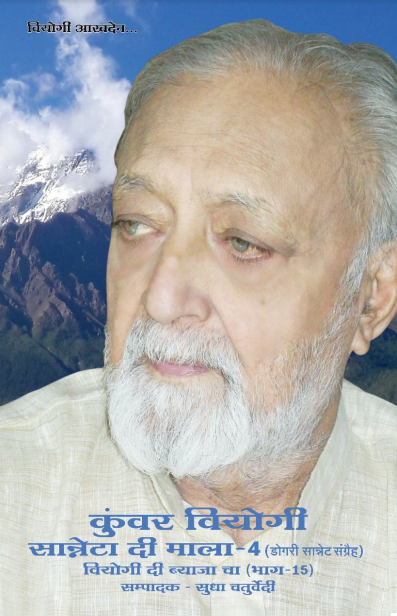
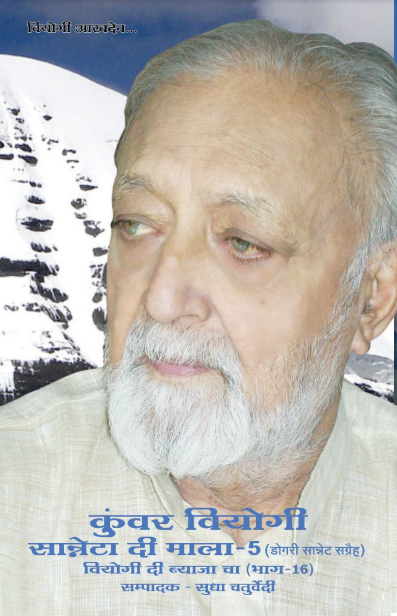
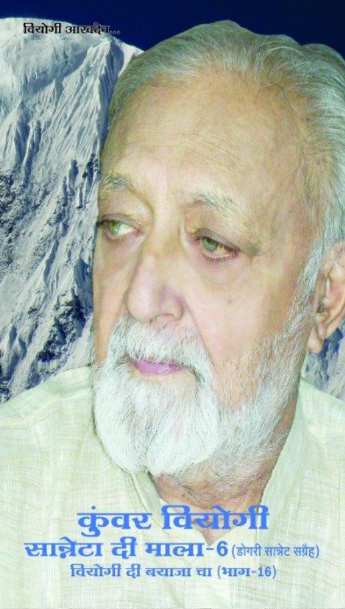
KUNWAR VIYOGI
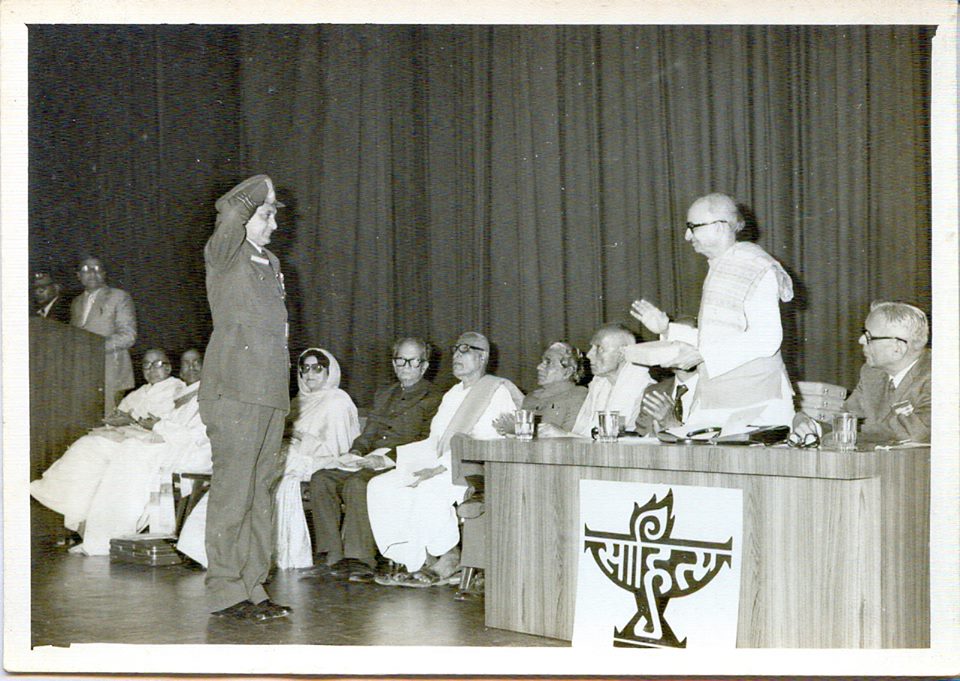
Sahity Akademi Award - 1980
Sahity Akademi Awardee Group Capt. Randhir Sigh,retd (IAF) fondly known as KUNWAR VIYOGI wrote 1789 sonnets in in two languages , English & Dogri. 365 sonnets in English & 1424 sonnets in Dogri without repeating any idea.
It is surprising that a Air Force Officer has written such great sonnets. A very rare combination of courage-bravery- sacrifies-quickwit-extravort and a soft-deep-sensitivity-philosofic idea-with SAKSHI BHAV-deteched-witness-global sight. Randhir Singh , is the only Indian Air Force officer to have received the Sahitya Akademi Award for his long Dogri language poem titled “Ghar” in 1980.
Kunwar Viyogi has made a great and remarkable contribution to the modern Dogri and English literature and also to journalism. He has not only enriched the literature of these languages but has also embellished them with Philosophical depth and solemnity. He will always be remembered for his sensitiveness, devotion to values, delineation of beauty and the true vision of the self. He has courageously attacked political and social evils and has stood for social reforms. Subtlety of feelings, profundity of thought, love, compassion, mysticism and consciousness of duty make his personality distinguished and unique. His extraordinary command on Dogri, English, Urdu and Hindi languages makes the expression of feelings and thoughts easy, lucid and interesting at the same time his prose is as impressive and interesting as his poetry is. Kunwar Viyogi has a rare gift of shifting immediately from antiquity to modernity and from traditions to latest ideas. With his broad and humanistic vision he can feel the suffering of the whole world in his own personal grief and the joy of the whole world in his own personal joy. External grief’s of the sensitive poet bind him to the world and at the sometime there is the lamentation of the infinite consciousness bound in the limits of time and space. External and internal sorrows are well expressed in prose but it goes to the credit of Kunwar Viyogi that because of his command on the languages, he has expressed them in an equally impressive way in verse also. In spite of not being very well-versed in figures of speech and nuances of language, he has been able to convey to the reader the innermost feelings of his heart. He has very aptly used similes, the objects which are compared, proper words at proper place and given expression to the deep meanings that he wants to convey. He very skillfully carries the reader from simple to complex and from concrete to abstract.
About Sonnet
Kunwar Viyogi says-
Dear Friends
I present to you, my book “First Croonings”(Sonneten Di Mala vol.I)
Sonnet writing is a completely new form of poetry in Dogri. It had its genesis in Europe. Of all the forms to have emerged from Europe, sonnet is the most comprehensive and an all-encompassing one. It can also be understood as a short poem of 14 lines. Ever since its origin in the 13th century, it has been in regular usage of the poetic compositions. The form has seen its rise and fallen outof favour but it never lost its sheen and went out of fashion completely. In every literary epoch of Europe and England this literary form has found wonderful compositions. The form and the compact structure are able to hold multilayered meanings that unravel the mysterious poetic truths.
The writing of sonnet, it is confirmed, had its beginnings in Italy in the thirteenth century from where it travelled to Tuscany and was picked up by Dante for his composition ‘Vita Nouva.’ It was nearly at the same time that the Italian poet Petrarch also adopted the form and wrote many timeless sonnets. It was Petrarch in the fourteenth century who endowed the sonnet with its characteristic form. He made it simple yet comprehensive and beautiful. It was he who revealed the scintillating beauty layered up in the depths of a sonnet. That is why, Petrarch is known as the ‘Father of the Sonnets’.
In terms of its structure, a Petrarchan sonnet has an octave and a sestet. The octave raises and describes an issue related to the heart, mind or society. Moreover, it conveys a stream of thought or emotion; history; politics; moments and ideas in the most substantive manner. The sestet deals with the resolution of the octave. The rhyme scheme of the octave is such that the first, fourth, fifth and the eighth lines rhyme with one another and the second, third, sixth and seventh rhyme with one another in the similar fashion. But the peculiarity of a sestet is that it is quite flexible. The six lines can be written in the form of three couplets or it can be written in the form of a quatrain and a couplet. The only restriction is that the first, third and fifth lines should rhyme with one another. Similarly, the second, fourth and the sixth lines should share the similar rhythmic pattern. So the rhyme scheme of a Petrarchan sonnet can be represented as abba abba cdcdcd.
The form that began in Italy spread rapidly throughout Europe and soon incredible sonnets were being composed in almost all the European languages. In England, the sonneteering began in the sixteenth century. Sir Thomas Wyatt and Henry Howard introduced the form in England. Initially they translated some of the Petrarchan sonnets and then went on to compose a few of their own. Following in their footsteps many other poets began to translate French sonnets into English. Amongst them was the renowned English poet Spenser. Due to these translations the form of the sonnet became a much discussed and admired trend in the English literary circles. The translators and the poets began experimenting with the form within the particular structure of their own language. This led to the emergence of an indisputably distinct English form of the sonnet. This form is what is also known as the Shakespearean form. This form is made up of three quatrains and a concluding couplet. In terms of the rhyme scheme the quatrains can be written independent of each other with the first lines rhyming with the third and the second with the fourth. The famous soneteers of the period were Spenser, Sir Philip Sydney, Samuel Daniel, Michael Drayton and others. These poets also attempted to use sonnets as a verse form in their fiction. The best sonnets of the period- lyrical, simple, nuanced and thoughtful- were those penned by Shakespeare. He wrote 154 sonnets in all for which he is acclaimed as a sonneteer, though his uninhibited poetic expressions in his songs and plays are no less. The rhyme scheme of the Shakespearean sonnet is abab cdcd efef gg.
Milton adopted the Italian form in his times and composed beautiful sonnets. A form that began as a satire or enunciation of the theme of love began to incorporate almost every aspect of life like philosophy, morality, ethics and others, by the Age of Milton. In poetry this form had well demonstrated its comprehensive, flexible, malleable and balanced expressions and the English language whole heartedly embraced it. The compact structure, pointed focus and balanced ideas made it a forceful and influential stream of poetry.
At a superficial glance one feels that between the Petrarchan and the Shakespearean form the former is more challenging. The Petrarchan form has been likened to the rising and the falling of the waves in their cadence. The Shakespearean sonnets due to their structure of four quatrains and a couplet appear simpler. Though it cannot be denied that the Petrarchan sonnet precincts a poet’s imaginative flight due to its rigid rhyme scheme, however, it is to be kept in mind that a sonnet deals with a single theme. This makes the Shakespearean form more challenging. It is quite difficult to present a situation or a conflict for twelve lines and reserve only the last couplet for resolution. In many instances the master craftsman himself was unable to provide a satisfactory resolution in the concluding couplet. A sonnet seems well rounded off only if itconcludes with the characteristic two lines that have the brevity of a proverb, comprehensiveness of voice, finality of a couplet and the flexibility of poetry. It may be likened to a bow and an arrow. One can pull back the string of the bow for twelve lines and then shoot at the last two. The shot must be so perfected that it not only targets and injures its mark but draws the very life out of it. If it achieves this, then alone does a Shakespearean sonnet realise its brilliance, complete in all the sixteen virtues of art. One finds an abundance of lyrical and musical sweetness in it.
Sonnets like the couplets of a Ghazal are spicy, quintessentialand decisive. They are neither too short to lose meaning nor too long to seem unwieldy. It is like a perfect fitted cap- neither too loose nor too tight. The sonnet penetrates our consciousness most easily almost like a thoughtless thought and the subsequent stirrings simply grip and entice the soul. Sonnet is that particular guise of poetry that encompasses within it the entire poetic expanse. It is a particular garb of poetry that gives its body a leviathan form.
Shelly, Keats and Leigh Hunt did not like the sonnet form much since to them its restrictive structure clipped the flight of their imagination. Yet, all three of them composed sonnets and freely used the form. Shelly’s “Ode to West Wind” and the best odes of Keats are written in the flow of a sonnet andthe critics world over agree that they are deeply influenced by the sonnet form. Very few sonnets of Wordsworth form part of the college curriculum. Mostly he is regarded as a Nature poet. Very few people know that he is a par-excellence sonneteer and has written more than five hundred sonnets. Many critics even assert that he is at his best in his sonnets. Apart from these, Elizabeth Barret Browning penned brilliant sonnets in the eighteenth century. Earlier American poet Longfellow and the more recent Robert Frost too composed many beautiful and profound sonnets. Even today the sonnet form is read, written and appreciated among the connoisseursof poetry. Modern English poetry, having lost its way in the maze of verse libre is turning back to metrical compositions as it is only the metre that distinguishes poetry as poetry. That is why I think it is obligatory for all the poets in different languages to understand the different poetic forms amongst which the sonnet f is like a vitamin shot that rejuvenates a weakening language. It is like an adrenal dose to a stoopingspine.
Before I proceed to write about my two hundred sonnets I would like to point out that in European languages Radeef(Radeef is the word/phrase that is repeated at the end of the second line in every sher) is not used. In these languages due to their structure, form and grammar the passage always ends with the Qaafia (Qaafia is the pattern of word(s) that rhyme and come just before the radeef in the second line of a sher). It is possible to attempt this in own languages but it sticks out like a sore thumb. The reason is that in our language the verb comes at the end of the sentence. The verb may be placed syntactically in a different position but it hinders the flow of the verse and at times with disastrous results. That is why in the present sonnets I have used Radeef as and when required in accordance with the simplicity of the language, flow of ideas and demand of the structure.
In writing the sonnet its lucidity, simplicity, sombreity,knowledge of diction and how to rein it in, all these assume great significance. In the absence of these the sonnet may appear to be aesthetically composed but it becomes lack-luster. I met and had an affair with the sonnet only after joining the college. The first ever sonnet that I read was “A Consolation” by Shakespeare. The ending couplet of the sonnet is
For thy sweet love remember’d, such wealth brings
That then I scorn to change my state with kings.
During those days I hardly understood English. By the time I reached the sixth grade, I had mustered some words of English by rote with great difficulty but the formation of paragraphs, the importance of punctuation and its use, and proper pronunciation were still way out of my reach. In reality, even our college professors were not proficient in them. Of all the professors who taught us English, I was most impressed by Prof. Nilambar Dev Sharma as far as technique and proper pronunciation were concerned. In view of these things, I really enjoyed his English conversations. Though his proficiency was not great yet his self-study of English and his technique were praise worthy. From his looks as well as his appearance, Prof Nilambar Dev Sharma looked like an Englishman and he would also dress up like one; he wouldalways be prim and proper in his carriage. In spite of his simple and calm disposition, his influence on us was tremendous and we would attend his lectures with great dedication. I would look at his face unblinkingly and try to emulate his manner of speaking. However, the bottom line is that despite my poor knowledge of English, when I first read the Shakespearean sonnet “A Consolation”, I simply fell in love with the form of the sonnet. The concluding couplet of the sonnet simply seeped into my being and became a part of me. In those days, I also read two other sonnet- Milton’s “On His Blindness” and Keats’s “On First Looking into Chapman’s Homer” – that left an indelible impression on my mind. I still remember these sonnets by heart. But what I admired the most was “A Consolation” and I would hum it from time to time. There was no one to guide us in this field and so like an amateur, I would read whatever I could lay my hands on. Whenever I would read sonnets I got the feeling as if it were a musical strain that I had experienced before and I felt quite familiar with it. There’s a word for this feeling in English borrowed from French Déjà vu which is beyond translation.
About Writings
Kunwar Viyogi wrote English sonnets with the same ease, simplicity, high quality and expertise. He had written nearly 365 sonnets 131 poems, 11 Gazals, 5stories, 6 Book reviews, essays, 11Kundalian, 16 Rubaian, 156Random thoughts in English. He also wrote more than 100 Features in English, published mostly in Kashmir Times.
It was his very unique quality to use languages at ease, both in prose and poetry. Mastery of languages–Dogri, English, Urdu and Hindi perhaps allowed him to play with words.
He regularly contributed to Sheeraja and occasionally to Kashmir Times and Times of India. In 1992-1994, he also worked as Assistant Editor in Kashmir Times (English) and Dainik Kashmir Times (Hindi). During this period he started the first one page Daily in Dogri namely Dogri Times. He used to regularly write the column “PATE DI GULL” ,( Heart of matter”), covering an entire gamut of subjects viz, metaphysics, literature, society, defense, international and national affairs and so on.
Sonnets - Books of Kunwar Viyogi
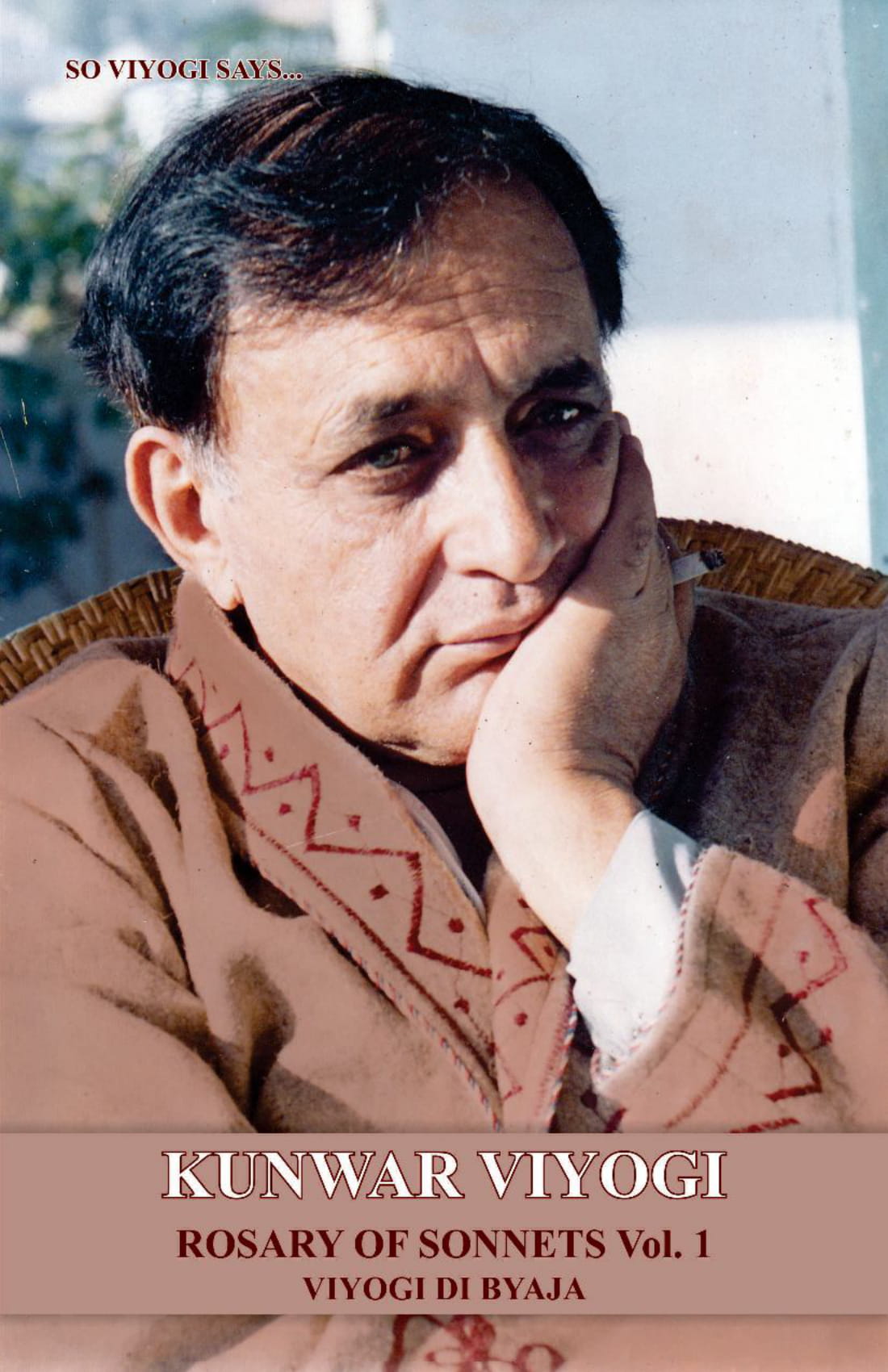
| 1.Rosary Of Sonnets vol. I | 185 sonnets |
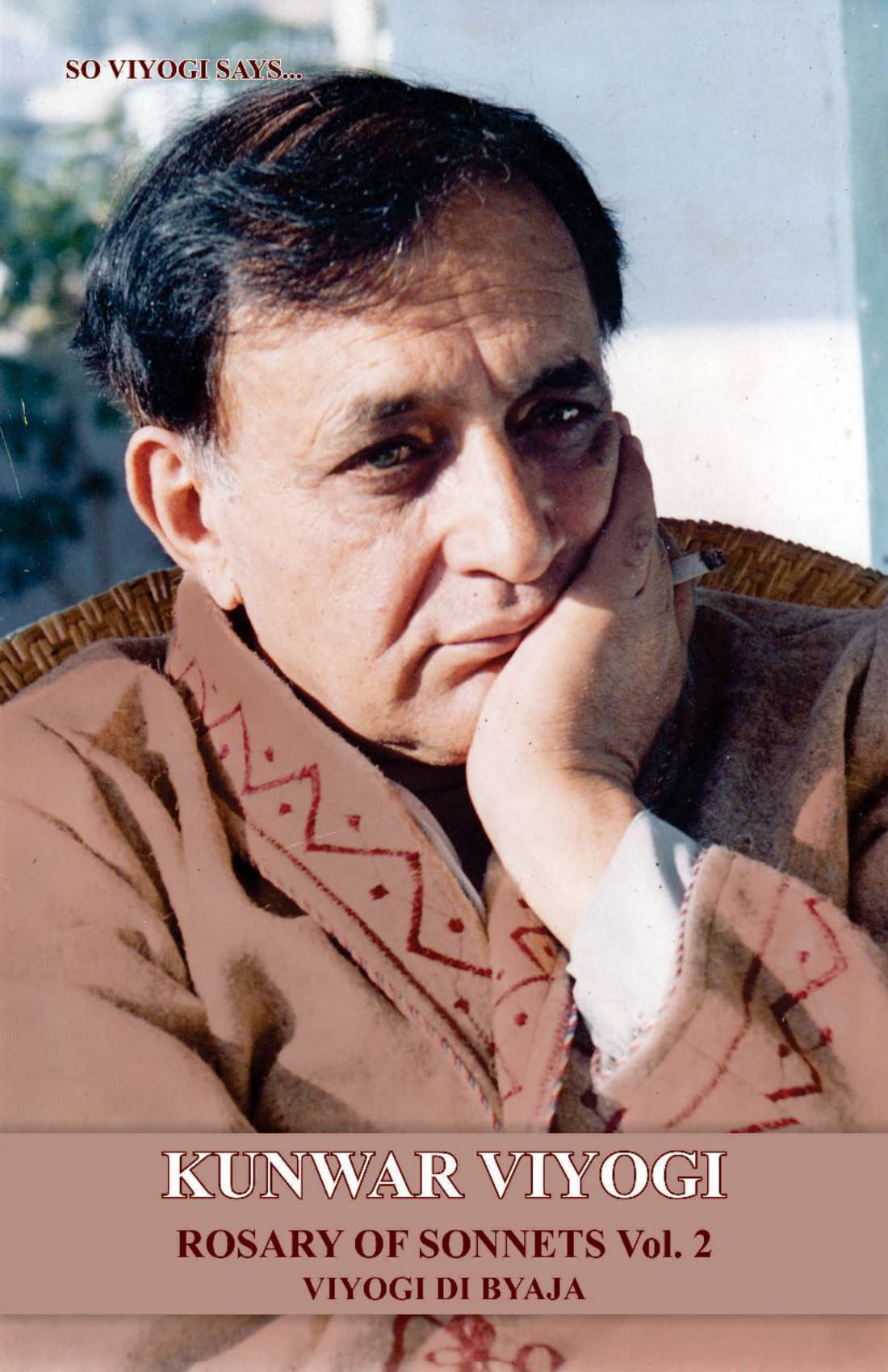
| 2.Rosary Of Sonnets vol. II | 180 sonnets |
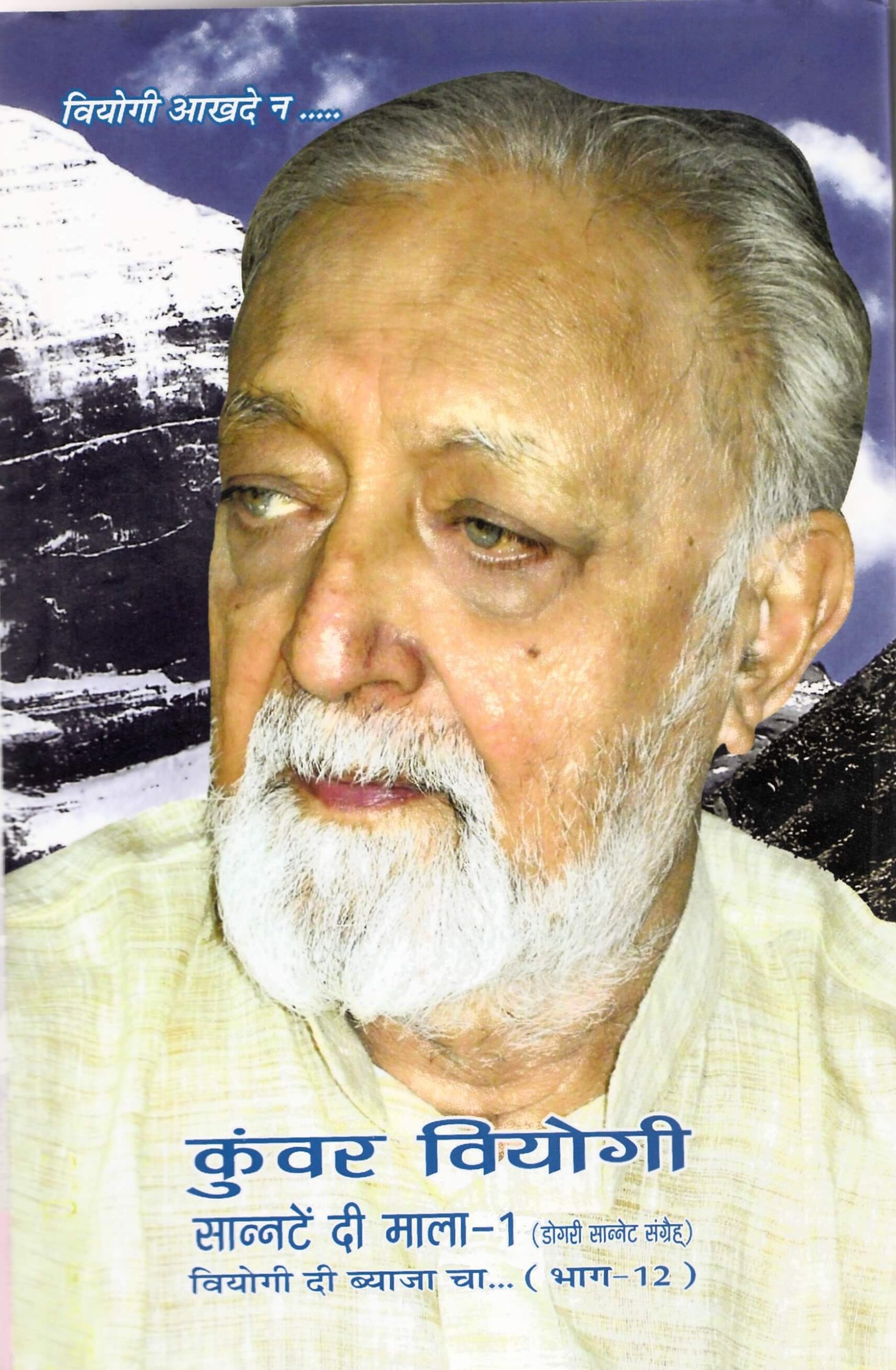
| 3. sonneten Di Mala vol. I | 200 sonnets |
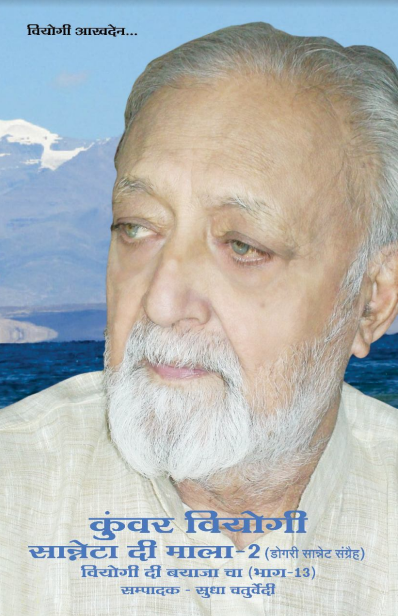
| 4. sonneten Di Mala vol. II | 238 sonnets |
| 5. sonneten Di Mala vol. III | 238 sonnets |
| 6. sonneten Di Mala vol. IV | 211 sonnets |
| 7. sonneten Di Mala vol. V | 220 sonnets |
| 8. sonneten Di Mala vol. VI | 266 sonnets |
| 9. Bhagat Job (Bible- The book of Job) | 51 sonnets |
| Total | 1789 sonnets |